Biodigester Community
Workshop #3
Biodigester Community
Workshop #3
WHEN
May 20, 2025
WHERE
Duwamish River Community Hub


Workshop Summary:
Drawing from the maps community members co-produced in Workshop #2, the JC3 team
synthesized community members’ drawings into 3 shuttle route options that were presented.
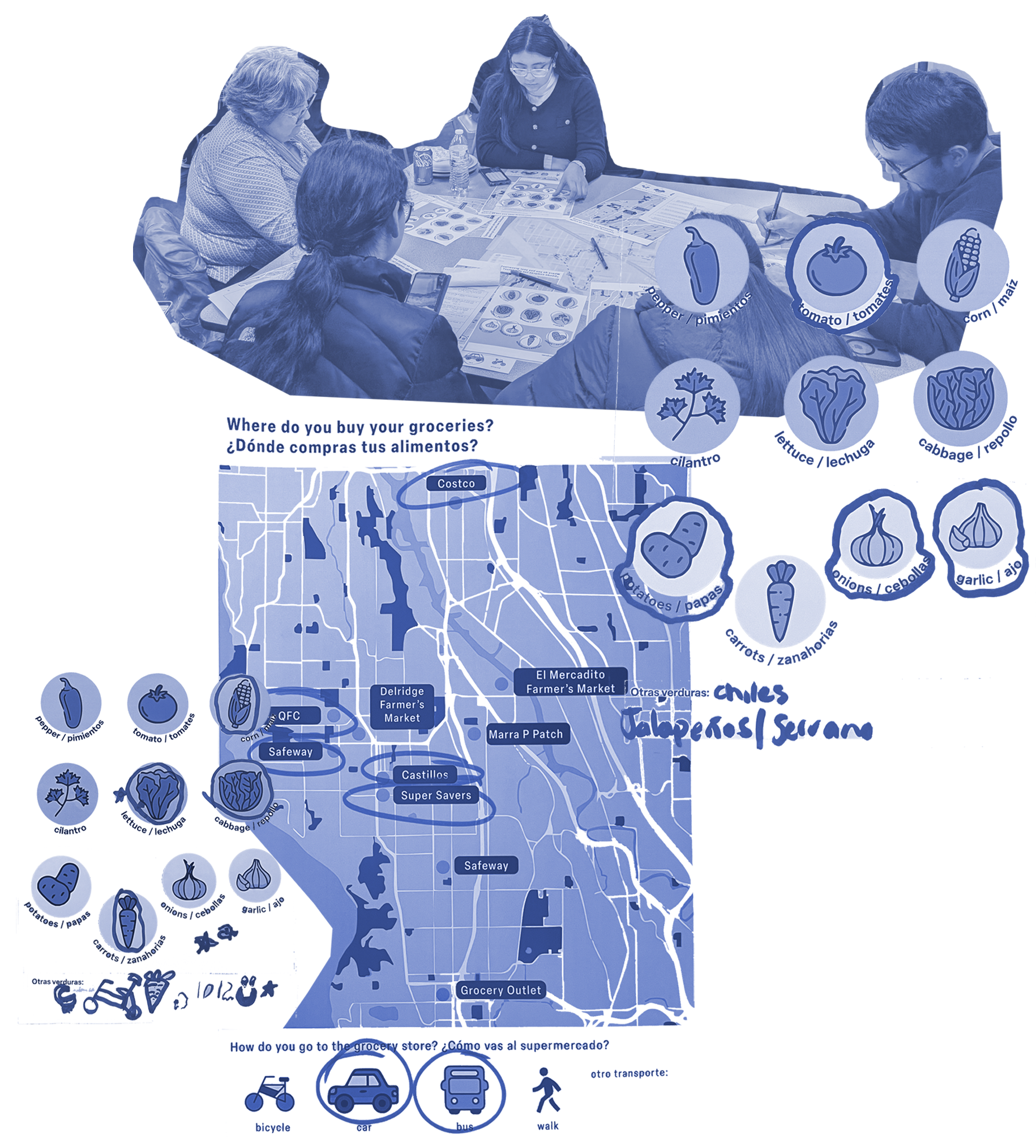
At Workshop #3, community members were seated in five small groups to engage in a
series of interactive activities that included ranking preferred shuttle route options and
providing feedback on the route, stops, lighting improvements, and other street improvements.
This session deepened the conversation around the biodigester project and its potential
to support a circular local economy through the development of a community-focused
micromobility network made up of a local shuttle, well-lit streets, and charging stations. The
information gathered in this workshop would go on to guide the creation of a South Park
Community Shuttle Concept Plan to be shared in Workshop #4.
Who Attended:
Duwamish Valley Sustainability Association, South Park Community Members,
JC3 Members: Sarah Chu, Sarah Maness, Catherine De Almeida
Workshop Prompts:
Which shuttle route do you prefer & why?
Where would you like to see lighting improvements on your preferred shuttle route option?
Where are 3 locations for E-Bike and E-Scooter Charging Hubs on your preferred shuttle route option?
Activity 1:
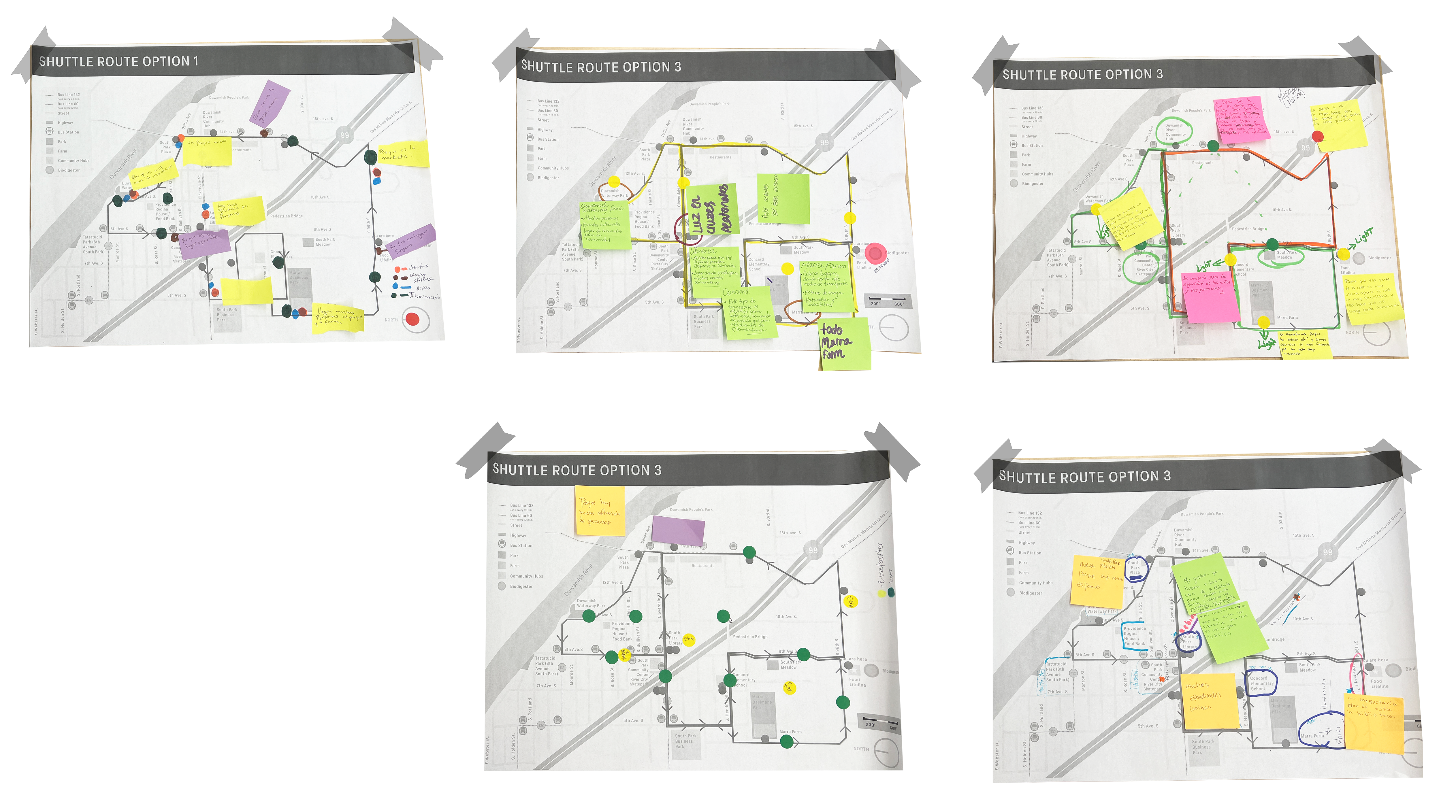
In small groups, community members were given printed materials of the three proposed shuttle routes
to review and rank according to their highest priority. Shuttle Route Option 1 included a single shuttle
route, with 11 shuttle stops, that traveled mostly on the edge of the neighborhood boundary established
for the purpose of our concept plan development. Shuttle Route Option 2 was also a single shuttle
route, but covered less territory and mostly stuck to the interior of the neighborhood, and only featured
7 shuttle stops. Shuttle Route Option 3 was a blend of both option 1 & 2, taking a 2-shuttle approach
to cover more area in the neighborhood and allow riders the opportunity to access resources at the
heart of South Park and outer edges. Route Option 3 also allows for riders to transfer between the two
shuttles, as there are overlapping locations for multiple shuttle stops. Each of these proposed shuttle
routes were designed based on feedback from Meeting #2.
In this first activity, using color-coded stickers and map annotations, groups indicated their preferred
routes with either a red sticker (for highest priority), a blue sticker (for moderate priority), or a yellow
sticker (for lowest priority) and suggested adjustments, such as additional bus stops or expanded
coverage. Many favored Option 3, a hybrid of Options 1 and 2, citing its balance between
time efficiency and area coverage. Some also noted that shorter walking distances to stops and fewer
transfers were essential considerations.

Activity 2:
Next, community members explored the idea of and potential locations for e-fleet hubs: Spaces for
charging and parking e-bikes and e-scooters. Using stickers and map annotations, groups identified
their ideal hub locations on large maps, selecting publicly-accessible areas like Duwamish Waterway
Park, South Park Library, Marra Farm, River City Skatepark, and the Duwamish River Community Hub.
The conversation emphasized accessibility, proximity to gathering places, and safety, especially for
youth or near elementary schools.
Activity 3:
In the final activity, community members were asked where lighting improvements are needed to
support safe, vibrant streets. Groups placed stickers and made annotations on maps to highlight key
locations such as Marra Farm, Duwamish River Community Hub, South Park Plaza, areas near the
freeway and pedestrian bridge, and industrial corridors like 96th Street. There was a strong consensus
on the need for better lighting in and around places where people gather, travel, or feel unsafe at night.
Members of DVSA clarified that lighting standards, including minimum luminosity and spacing
requirements, would be incorporated into the final report.
Outcomes and Next Steps:
This meeting confirmed strong community interest in biodigester-powered infrastructure that meets everyday
needs, especially mobility, food access, and safety. Participants offered thoughtful input on not only what their
preferred route option is, but also where to make small adjustments to better serve community needs and
priorities. The identification of where e-fleet hubs would serve the most people and how lighting can contribute
to a sense of safety and dignity in public space were also key outcomes. Community feedback directly informed
the next phase of design refinement, including placement strategies for shuttle routes and stops, e-fleet hubs,
and lighting improvements. It also reaffirmed the importance of co-creating solutions that address
environmental, economic, and social goals simultaneously.