Biodigester Community
Workshop #1
WHEN
November 14, 2024
WHERE
Duwamish River Community Hub


Workshop Summary:
This initial workshop aimed to help community members understand key concepts of circular
and regenerative economies and introduce three potential community benefits the
large-scale biodigester could support – and how they could be locally integrated into both
municipal and community systems. The workshop started with introductions and an overview
of definitions of linear, circular, and regenerative economies, providing case studies as examples
of those concepts in practice. The small-scale biodigester at Food Lifeline, operated by DVSA,
was also presented as an example of how specific benefits could be scaled up if the biodigester
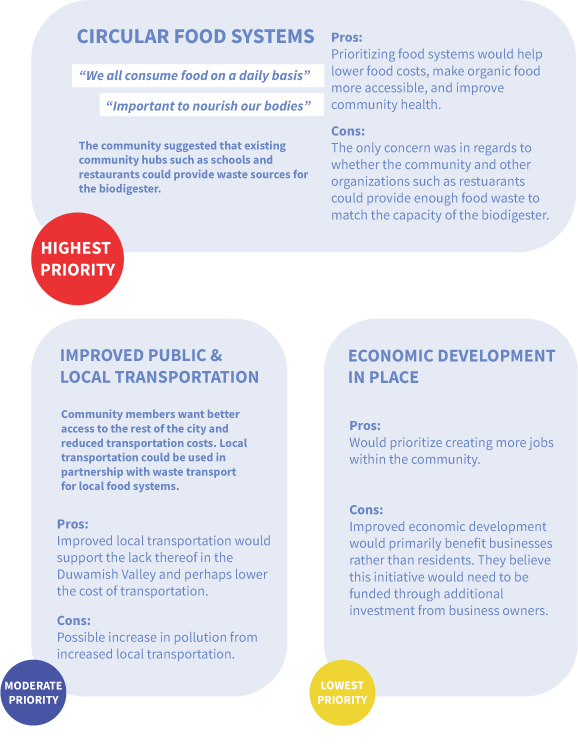
were to increase capacity and become feasible. The primary engagement activity asked
community members to review three options that were presented in diagram form, and select
which was their highest, medium, and lowest priority.
Who Attended:
Duwamish Valley Sustainability Association, South Park Community Members,
JC3 Members: Sarah Chu and Catherine De Almeida
Workshop Prompts:
What are your priorities for the community benefits of the biodigester?
How do you rank improved local transportation, local food systems, and economic development?
Activity 1:
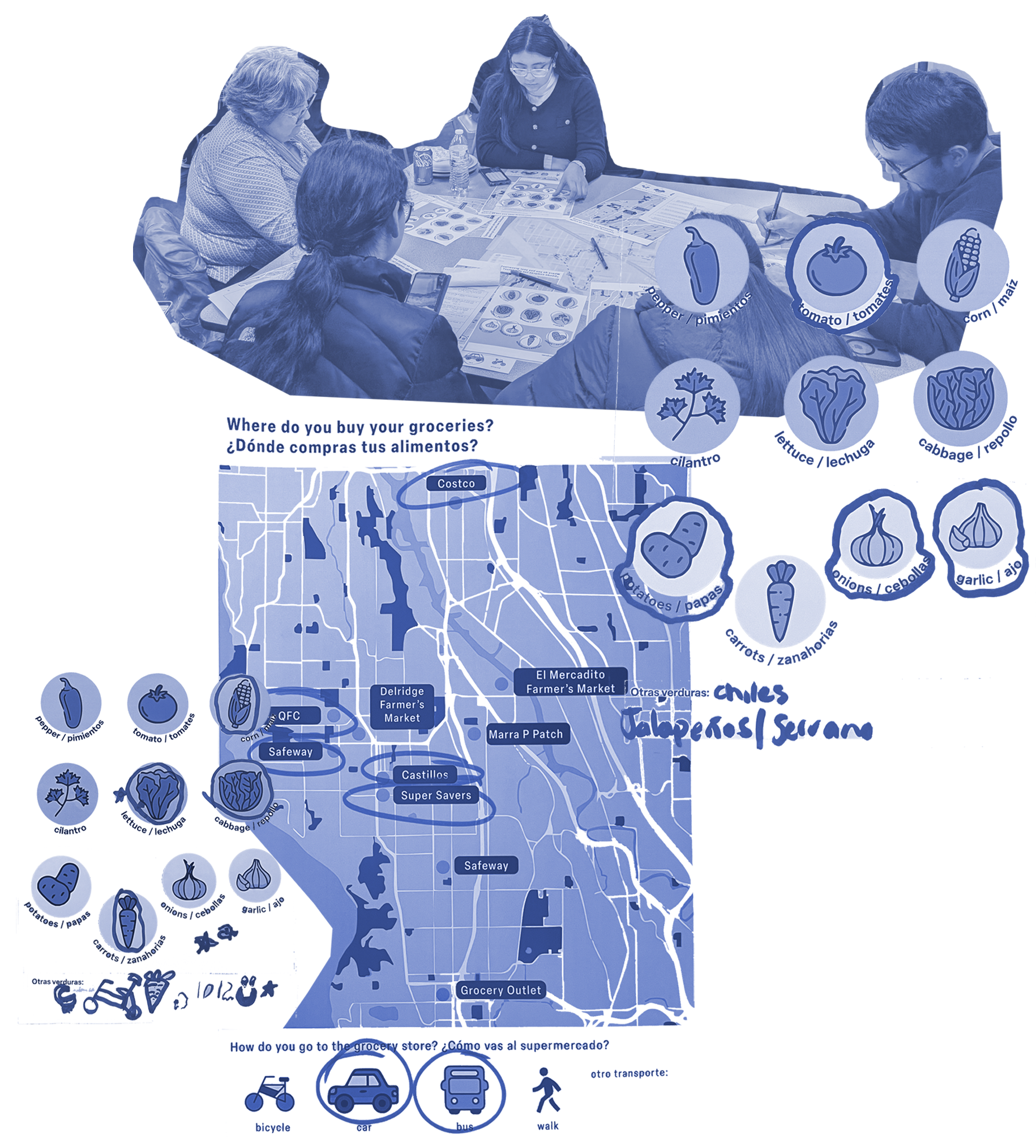
Community members sat in groups of 4-6 people and were given informational sheets, in both
English and Spanish, outlining the different types of benefits provided by the biodigester. These
were: improving the local economy and local jobs by providing renewable natural gas to local
food businesses, local transportation, and food systems. After reading through each description
and reviewing the accompanying visual, participants were given three different colored
stickers: each representing a different level of priority. Participants worked collaboratively
through discussions at their tables to visualize their priorities using the stickers, adding
post-it notes with their own questions and ideas. A share-out followed, where one community
member per group came up and presented a summary of their conversation and decisions. The
workshop closed out with sharing how we would process this information, and our intentions for
the next workshop, including how we would integrate our learnings into new materials moving
forward.
Outcomes and Next Steps:
Through this first workshop, the team learned more about the community’s priorities
surrounding the benefits of the large-scale anaerobic biodigester. Additionally and
beneficially, the team was prompted to think about new questions and ideas the
community presented. For example, one group of participants suggested that local food systems
could benefit from existing community hubs such as schools and restaurants by collecting
their waste as resources for the biodigester. Health concerns were also strongly expressed
as of utmost importance, in addition to the high cost of healthy food and safety of transportation.
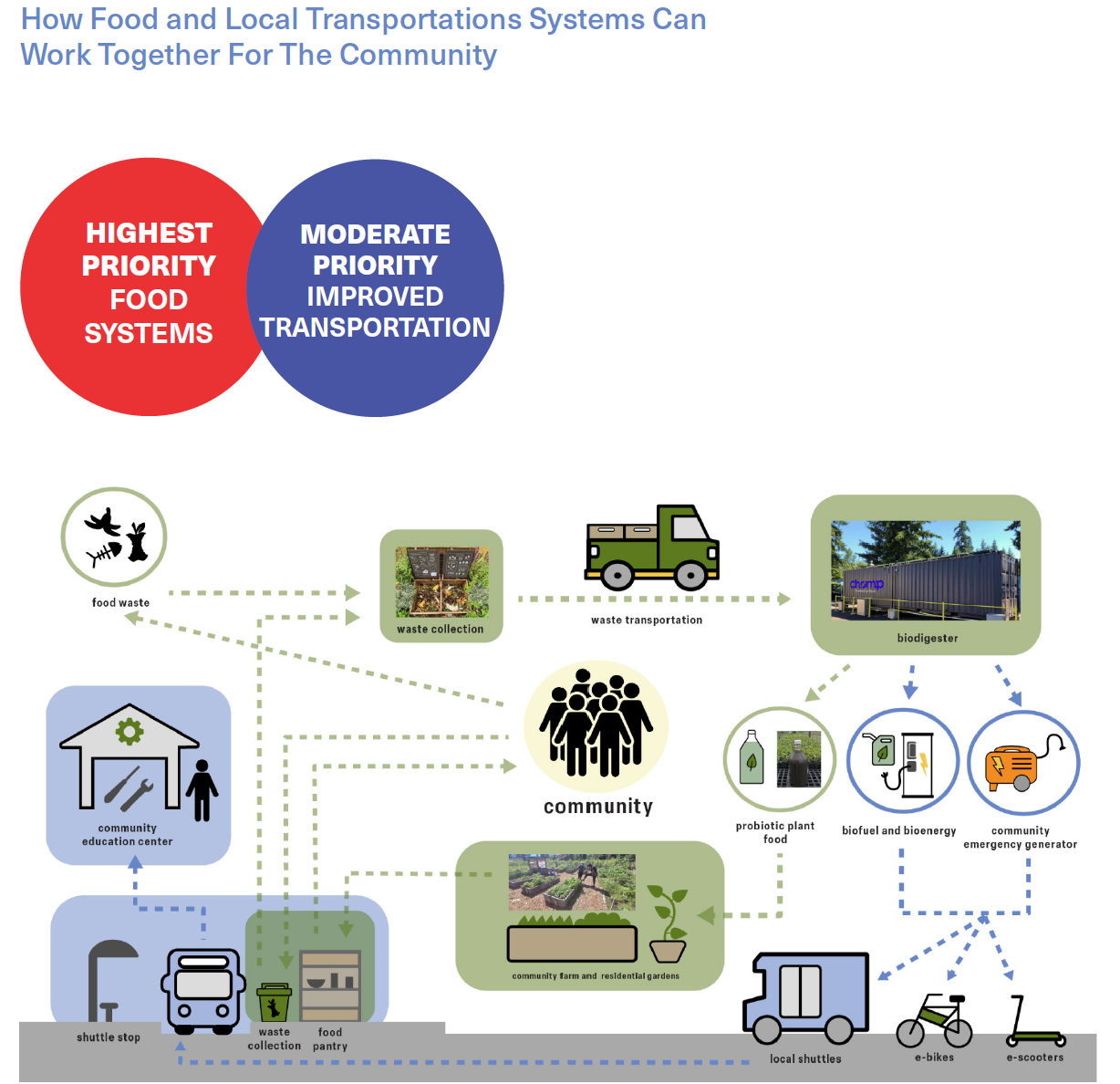
Going forward, the JC3 team attempted to not only process the information, but to think about
how the biodigester could integrate benefits for both local food systems and transportation. The
team also became interested in more specifically capturing how local transportation could be
improved for the needs of the community, which included new stops, routes, improved lighting,
sidewalks and roadways–the primary focus of the next workshop.