studio | Design Manifestos for the
End of Capitalism:
Speculative Visions + Narrative
Landscapes for a Changing Climate
professor | Catherine De Almeida
year | 2024-2025
︎︎︎Design Manifestos
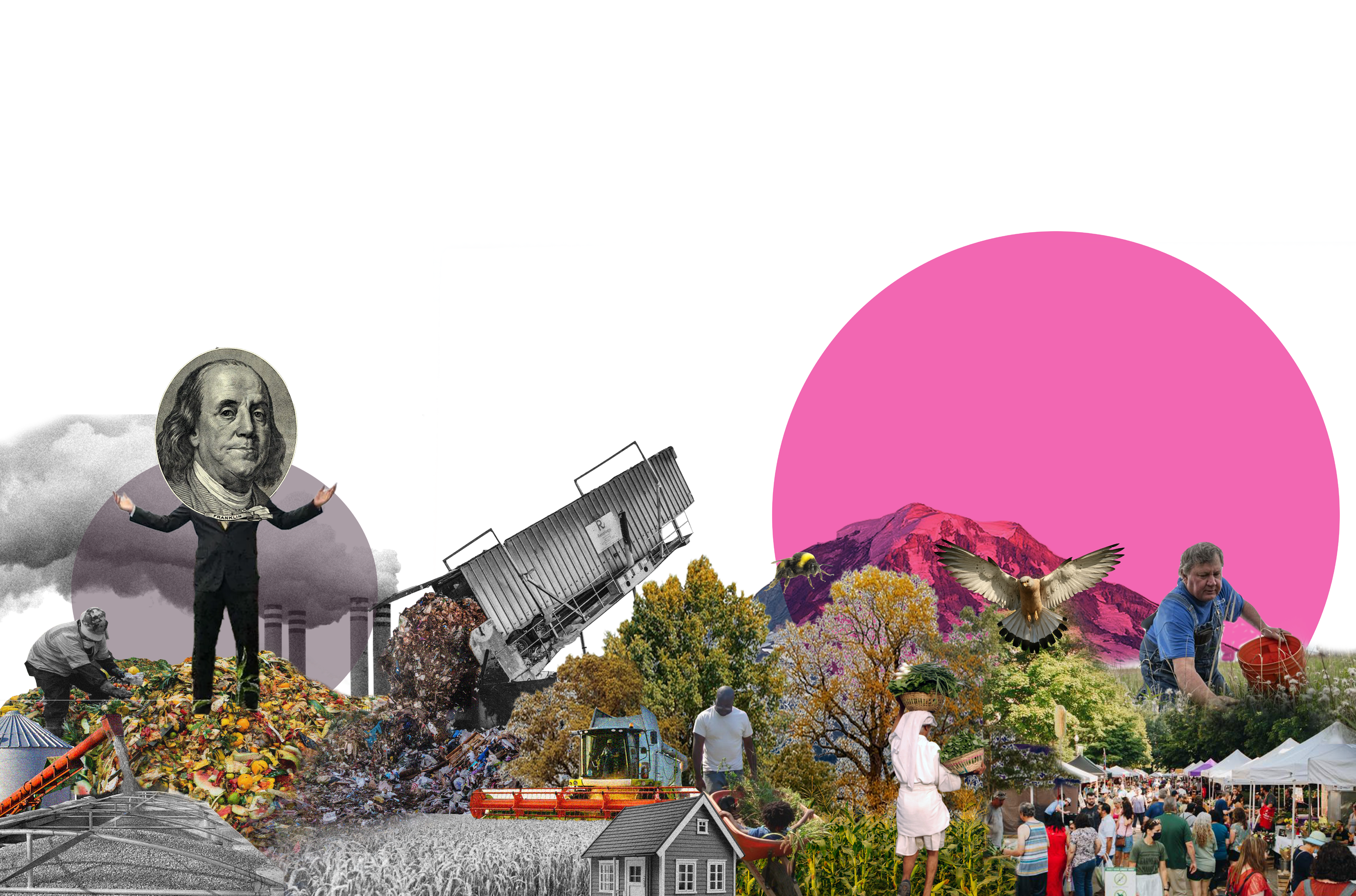
(Food For All, For All Time: A Design Manifesto for Accessible and Local Food Systems. Project By Joanna Chen)
“…it is now easier for us to imagine the end of the world than an alternative to
capitalism.” Anthony Dunne and Fiona Raby, Speculative Everything, p. 2.
It is somehow easier to imagine the dystopian destruction of the physical world than the restructuring
of socio-political and economic systems that determine the physical, structural, aesthetic, and
operational outcomes of built environments. This is our starting point: challenge accepted.
Capitalism dictates how built environments are planned, physically formed, managed, what they rely on,
who they harm or benefit, privatized ownership structures, among many other internal and external factors
that underlie the human-visioned and created world that we inhabit today. Envisioned as a system
grounded in democratic values, we live in the consequences of profit-driven practices that concentrate
capital, sacrifice certain landscapes and communities for the benefit of others, exacerbate social and
environmental injustices, and have accelerated climate change and its asymmetrical impacts.
Capitalism relies on carbon-intensive linear systems of extraction and disposal that disregard ecological
and social life and place-based relations that support belonging. Transitioning to a decarbonized future
offers potential to reimagine not only the sources of energy that fuel society, but also the very structures
that govern and support their existence.
This is not the first time human societies have been faced with massive transitions. For example, the
post-World War II era lended itself to technological advancements that led to both the visioning and
construction of a society dominated by the promise of technology, mainly private and individualized
modes of transportation like the automobile and airplane. As consumerism took off, so did a transition
from a mind-set of collectivism to one of individualism.
During this time of transition, architects engaged with the hope and promise brought on by these emerging
technologies and underlying cultural shifts that were occurring in post-war America. Architects like
Frank Lloyd Wright, Le Corbusier, Archigram, Paolo Solari, and many others put forth utopian visions
that forecasted imagined and idyllic worlds formed by emerging technologies of the time. Solari’s Arcosanti
is an example of how that vision has become materialized.
Learning from utopian visions from the 20th century, the work of science-fiction writers, notably Octavia
Butler, and examples of manifestos by designers put forth over the last decade, students will continue to
develop their own design manifestos not for the end of the world, but for the end of capitalism as we
transition to a decarbonized future. Prior to beginning the studio, students spent the fall quarter developing
their manifestos, determining their core topic and critical stance, selecting key case studies and literature
to support their project development, developing a project plan, and an initial attempt at a zine. Students’
manifestos defined a thematic focus that now dictate their design research exploration for the next two
quarters. Each project established relatively clear topics and trajectories for the work.
Students further narrowed their scope and began to test their ideas, shifting manifestos from written
vision to a design manifesto that becomes actualized through narrative and story-telling that articulates
their speculative visions for the end of capitalism / post-capitalist futures.
These eleven design manifestos contend that design practice and speculative relations can break away from
the systemic harms caused by and perpetuated by capitalism. These projects range from reimaging streets
without cars to argoforestry practices in Indonesia; from landfill futures in Deonar, Mumbai to the future
of combined sewer systems in Chicago; from reimaging new design praxis and processes to engage with
youth or ethics of care to engaging with contaminated sites or waste streams through empowering citizens
most impacted by these sites to enact processes of transformation.
Acknowledgements
Capstone Design Studio Students: Joe Minsky, Radhika Sarda, Chanel Chang, Jill Chao, Jingyao Wu, Sam Sachs,
Griffin Cronk, Ellee Ruder, Tina Lee, Liz Forelle, Matthew Jernigan, Joanna Chen, Ying Shan, Nidhi Jain
Reviewers: Shannon Lee, Andrew Prindle, Nat Gregorious, Robert Hanlon, Rhys Coffee, Karen May, Paul Peters,
Nathanel Cohen, Doug Jones, Jake Minden, Kasia Keeley, Lynne Manzo, Ken Yocom, Debbie Pressein, Erin Jacobs,
Keith McPeters, Matt Grosser