Learning By Doing: A Design Manifesto
To Center Youth Voices Through a
Series of Engagement Workshops
Liz Forelle
Capitalism’s main objective is to make a profit and to promote self-interest (1). This can lead to
economic prosperity in a capitalistic society. It encourages a place for individualism and competition
with others where people act for the pursuit of their own good without considering socio-political
pressure (1). Services that we provide for ourselves and our community are seen as less important
than things that are produced for a sale on the market (2). There is high value on efficiency,
productivity, and the final product. Spaces that are not seen as efficient or productive do have value.
This extends to those we see as productive members of society.
Youth are not considered members of our society, but rather people that will grow up to be members
of society. We focus on ‘the future of society’ and how ‘children are the citizens of tomorrow’ instead
of the importance of children today being current and active members of their community (4). In the
context of design, the final product has a higher value than the process of getting there. There is not
enough time or value in the typical design process to engage with community members, especially
with youth. Slowing down the design process to allow time for learning by doing and centering youth
voices, will allow for a greater sense of belonging and stewardship of a place. This will help youth feel
like they are part of their community and have the power to make change. Designers have an
opportunity to create a space of care for youth. This starts with centering a reciprocal driven society
where time is not considered a scarce resource (3). The relational self should be put at the center of
meaning-making through relationships, both collectively and individually (3). If we don’t care, we can’t
create a flourishing society and planet.
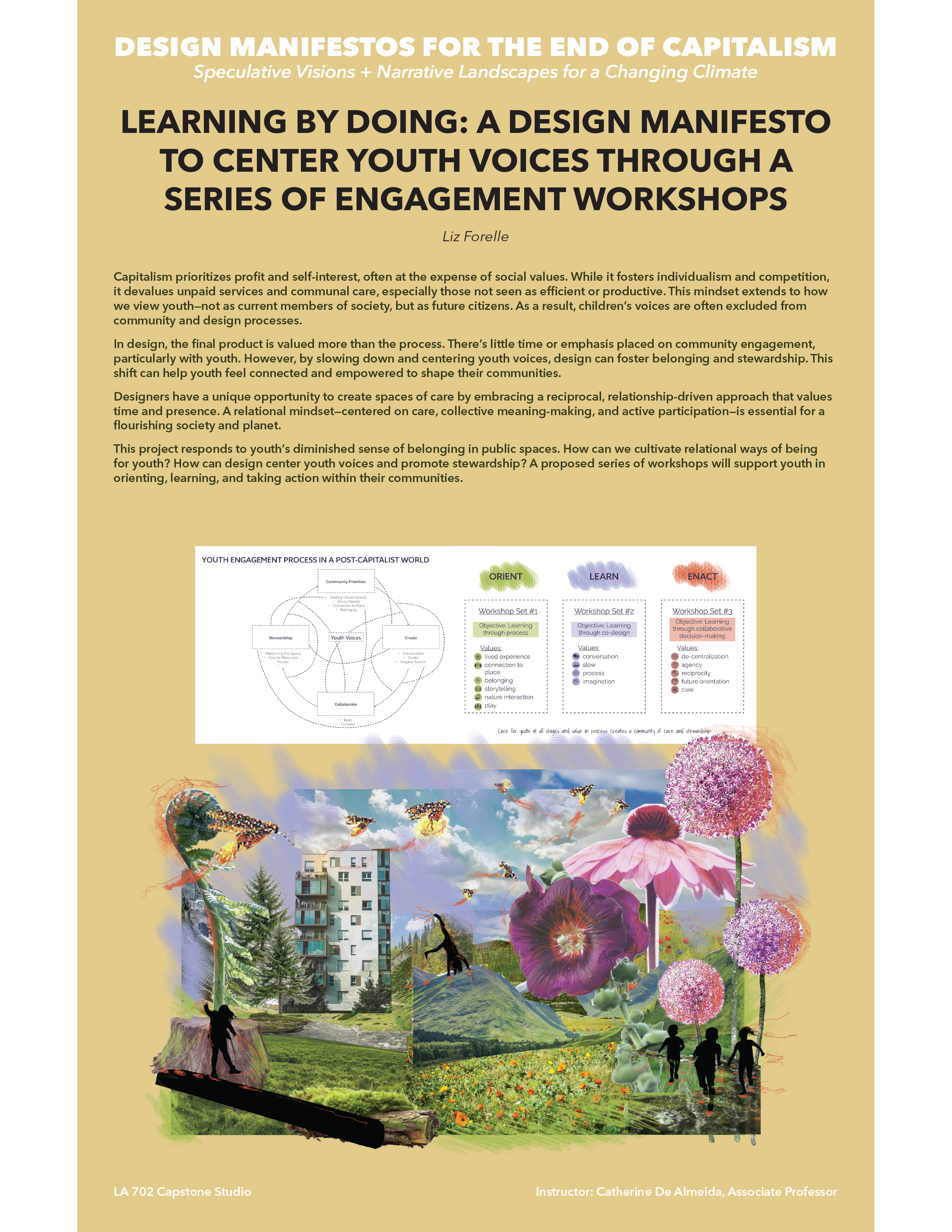
This project responds to youth’s diminished sense of belonging in publi spaces. How can we cultivate
relational ways of being for youth? How can design center youth voices and promote stewardship?
A proposed series of workshops will support youth in orienting, learning, and taking action within
their communities.
(1) Jahan , S., & Saber Mahmud, A. (2018, May 10). What is capitalism?. IMF. https://www.imf.org/en/Publications/fandd/issues/Series/Back-to-
Basics/Capitalism
(2) Taylor, C. (1960, April 1). Charles Taylor, what’s wrong with capitalism?, NLR I/2, March–April 1960. New Left Review. https://newleftreview.
org/issues/i2/articles/charles-taylor-what-s-wrong-with-capitalism
(3) Lynch, K. (2022). Care and capitalism : why affective equality matters for social justice. Polity.
(4) Loebach, J., Little, S., Cox, A., Eubanks Owens, P., & Owens, P. E. (2020). The Routledge Handbook of Designing Public Spaces for Young
People: Processes, Practices and Policies for Youth Inclusion (1st edition., Vol. 1). Routledge. https://doi.org/10.4324/9780429505614


