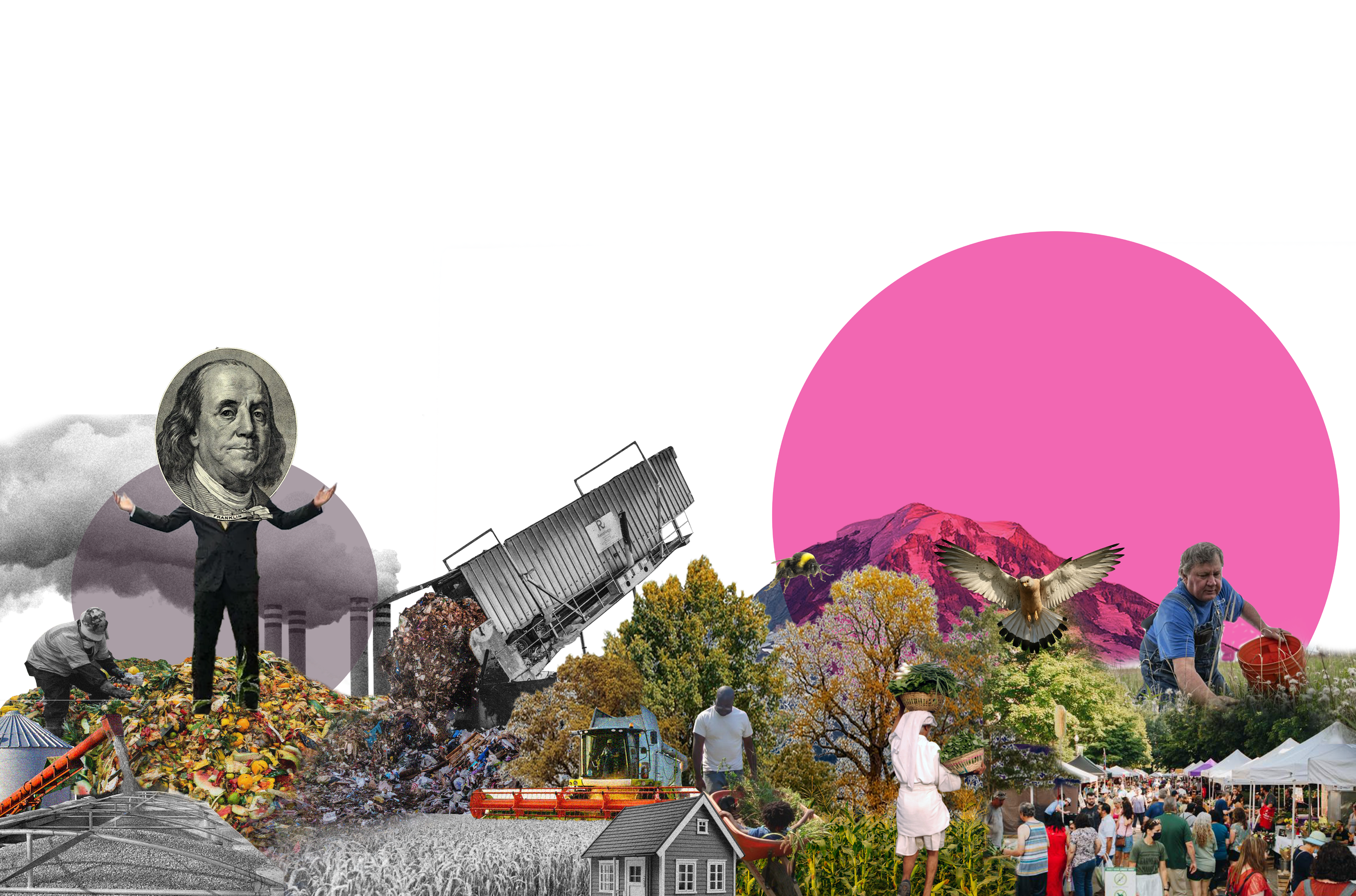
Food For All, For All Time:
A Design Manifesto for Accessible
and Local Food Systems

Joanna Chen
Food insecurity is deeply rooted in the way American landscapes are designed and planned. It’s a harsh
reality to grapple with, and maybe even one that goes unnoticed by most. However, the unfortunate truth
is that this issue is alive and prevalent in America. There is no such thing as a shortage of food in America.
In fact, the USDA estimated in 2010 that domestic food supply provided 4,000 calories per day per
capita (USDA, 2015). Almost double the recommended 2,000 calories per day per capita. Rather, access to
and quality of food are two key takeaways in understanding food insecurity. The US Department of Agriculture
(USDA) describes food insecurity as: “a household-level economic and social condition of limited or uncertain
access to adequate food” (USDA, 2024). In 2020, over 15% of American households experienced food
insecurity at some point in the year (NIHMD, 2024). A study conducted by the USDA in 2012 also discovered
that low income and minority households were most likely to experience food insecurity (Dutko et. al, 2012).
Alleviating the effects of this issue cannot be solved purely by physically altering the landscape. Calling upon
Damian White’s discussion of Just Transitions, “all conceivable programs for just transition are going to be
socio-technical in nature, multi-scalar and, by definition, concerned with designing low-carbon futures”
(White, 2020).In the context of food insecurity, the issue will not be solved by merely producing more food.
The structures in which we distribute food are inherently unjust under a capitalist society, and unless we look
into dismantling that system, the problem will persist.
There is no world and no reality in which a nation with such a dominant agricultural industry should have citizens
who are uncertain of their next meal. A systematic shift in the way we produce and distribute food is necessary
in order to dismantle these inherently unjust capitalist structures. It’s time to re-shape the urban food web.